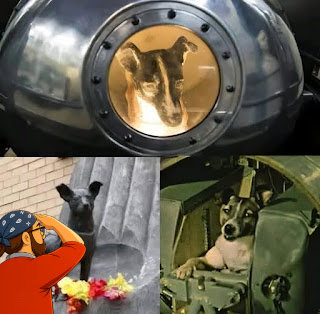
Even though her Launch was in November, I always take a quiet moment to remember Laika and her “sacrifice” for humanity randomly. I saw this post on a facebook page so naturally it drudged up all sorts of feelings on the topic of ethics in science and where to draw the line. This is a prime example of why science needs a leash
If left unchecked we can rationalize all sorts of horrors for ‘THE GREATER GOOD’
It’s been 67 years since she was sent into space. Not many talk about it now, but I think we should. Not because I’m a scientist or anything like that, but because it still matters….
Laika wasn’t just a dog in a rocket. She was a gentle presence full of trust. Her real name was Kudrjavka, which means “curly” in Russian. But the world came to know her as Laika — the little barker.
She was a stray found on the streets of Moscow. She was chosen because she was calm and had survived tough conditions. As if hardship somehow made her more suitable to be sent away with no way home.
On November 3rd, 1957, they launched her aboard Sputnik 2. The capsule had food, water, and padded walls. But no return plan. From the start, it was never about bringing her back.
Some say she lived seven hours. Others say a few days. Either way, she spent her last moments alone, floating in silence, not knowing why she was there. Just drifting, while Earth moved slowly out of reach.
She circled the planet 2,570 times before the capsule burned up on re-entry the following April.
And the truth is, Laika didn’t choose any of this. She didn’t sign up to represent science, progress, or the space race. She was just a dog. A little creature that wanted warmth and affection — and instead became a symbol.
That’s why I remember her. Because not all progress is kind. And not all breakthroughs are made the right way.
Laika’s story reminds us to ask better questions. To think about who pays the price for our achievements.
We haven’t forgotten you, Laika. And we never should.
Regards,
Barry from Support
Source of quote: FACEBOOK ARTICLE
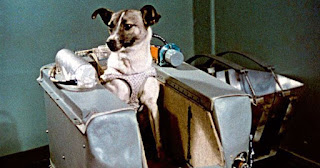
Who Laika Was & Why She Was Chosen
Laika was a small mixed-breed stray dog found on the streets of Moscow in the mid-1950s, chosen by Soviet scientists precisely because street dogs were believed to be hardy, adaptable, and accustomed to harsh conditions. She was trained alongside other dogs for spaceflight—enduring centrifuges, confinement in tiny capsules, loud vibrations, and restrictive harnesses. The Soviet space program needed a living test subject to determine whether a mammal could survive launch, weightlessness, and orbital conditions. Laika became the face of that gamble, not because she was exceptional, but because she was expendable in the eyes of the state.
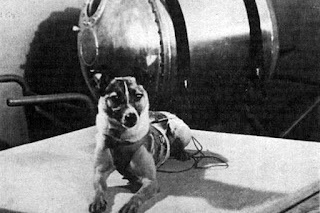
The Launch and Its Purpose
On November 3, 1957, Laika was launched aboard Sputnik 2, just one month after the success of Sputnik 1. The mission’s purpose was blunt and unprecedented: to gather biological data during orbital flight, even though engineers knew there was no plan—or technology—for her return. Sensors monitored her heart rate, breathing, and blood pressure as the spacecraft reached orbit. At first, the data showed extreme stress during launch, followed by partial adaptation to microgravity, proving that a living organism could survive liftoff and function in space, at least briefly.
Her Tragic Ending
For decades, the Soviet Union claimed Laika lived for several days before being humanely euthanized. The truth, revealed years later, was far more tragic. Due to a thermal control failure and insulation issues, Sputnik 2 overheated. Laika died from heat stress and panic within hours of launch—likely during her fourth orbit of Earth. She never had a chance to return, never had a chance to be saved, and never consented to the mission that ended her life. Her death became one of the earliest and most haunting reminders of the human cost embedded in early space exploration.
Her Lasting Contribution to Space Exploration
Despite the cruelty of the mission, Laika’s flight provided critical data that directly influenced the future of space travel. Her mission helped scientists understand life-support requirements, stress responses in microgravity, and the necessity of temperature regulation in spacecraft—lessons that informed later missions with animals and ultimately humans. Just four years later, Yuri Gagarin orbited Earth and returned safely. Laika did not die in vain, but that truth does not absolve the methods that led to her death. Her legacy is inseparable from both scientific progress and moral failure.
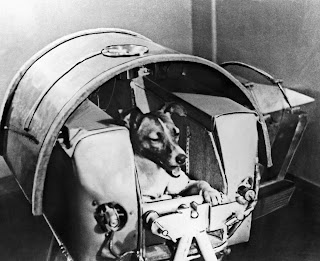
If you’d like to know more about LAIKA may I recommend her WIKI entry HERE
Bonus Paragraph — A Warning About Unchecked Science
Laika’s story endures as a cautionary tale about unethical science and the dangers of progress divorced from responsibility. In our modern age, the stakes are far higher: we manipulate genetics, engineer artificial intelligence, and probe cosmic forces capable of reshaping reality itself. We live in a world where theoretical experiments brush against the creation of black holes and technologies whose consequences we cannot fully predict. Scientific discovery must never become reckless ambition wearing the mask of inevitability. The line between playing god and acting as stewards of knowledge is razor thin—and the responsibility to tread it carefully lies with us. Progress without ethics is not advancement; it is a warning we choose to ignore.