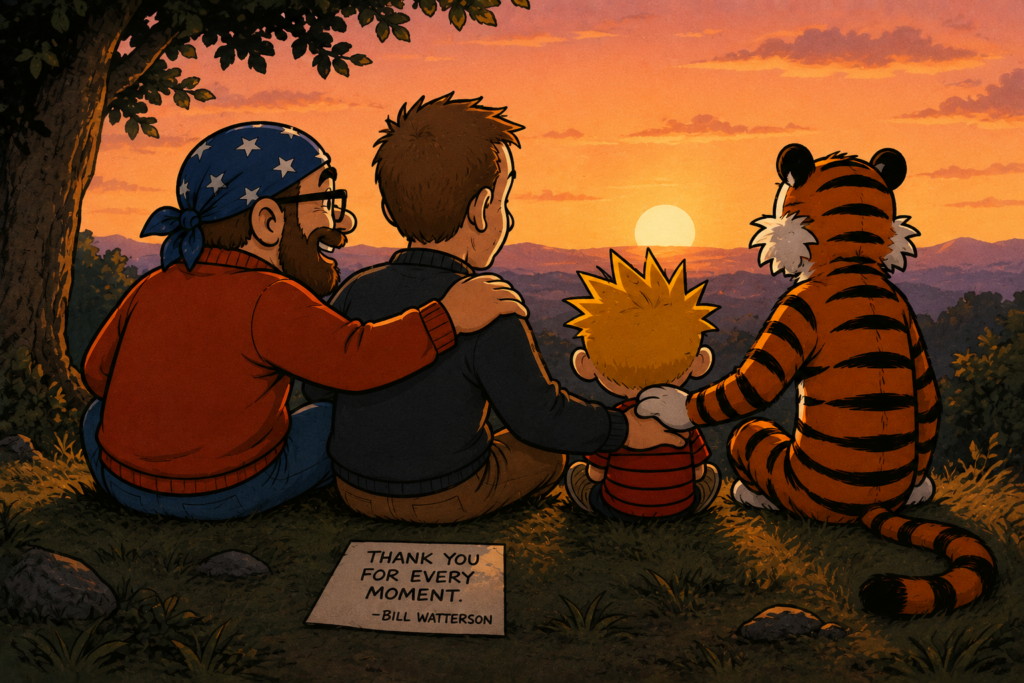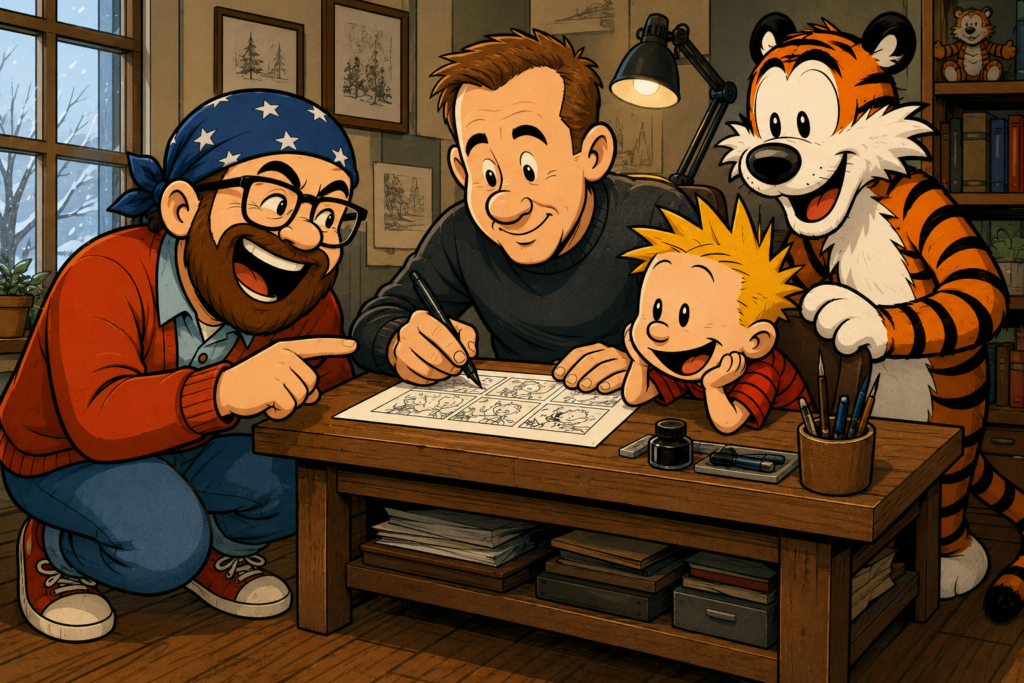
Are you a fan of Calvin and Hobbs? I am…… as well as millions and millions of other people. It was witty and fun and innocent (well…) IT just had a unique spirit to it. I was a kid when it was in full swing and I was in Elemantary school when they ended it. I’d be lying if I said I can remember the day, but while doing some research for this article I definitely got a rush of NOSTALGIA. This and Garfield were my introduction to comics (well, comic strips…..but same difference IMO). Ok, so let’s get into the story…. TIME TO GET EDITORIAL!
The Ending Nobody Wanted
December 31, 1995, marked the end of something millions of newspaper readers had grown up with.
Bill Watterson published the final Calvin and Hobbes strip after more than TEN YEARS of imagination, chaos, and childhood philosophy. It was the END OF AN ERA…
IT wasn’t like readers didn’t know the strip was ending either, quite the opposite, because Watterson had announced his decision weeks earlier.
What they didn’t know was that Calvin and Hobbes would leave the funny pages without ever becoming a conventional franchise. Honestly I don’t think anybody did, it wouldv’e been PRIME time to cash in on it too but that day never came.
There would be no animated series, corporate toy line, or endless parade of new adventures after Watterson walked away (just bumper stickers of them peeing on everything apparently).
The final strip offered something remarkably simple instead of a grand finale.
Calvin and Hobbes find the world transformed by freshly fallen snow and immediately see it as an opportunity (classic).
Their sled is ready, the landscape is wide open, and another adventure seems inevitable.
Calvin tells Hobbes that the world is magical before the two friends disappear down the hill.
It was an ending that didn’t really feel like an ending, which was probably exactly the point. IMO it’s how you end on both an band and a whimper (in the best sense that is)
The Man Behind Calvin and Hobbes
Bill Watterson created Calvin and Hobbes while trying to establish himself as a professional cartoonist.
The strip debuted in 1985 through Universal Press Syndicate after an earlier syndicate rejected it.
Its central characters were a wildly imaginative six-year-old boy and his stuffed tiger, whose adventures blurred reality and imagination.
Watterson named Calvin after theologian John Calvin and Hobbes after philosopher Thomas Hobbes.
Within a remarkably short time, the strip became one of the most successful comics in the world.
Shoot… At its peak, Calvin and Hobbes was BIG, like ‘BIG’ big. I’m talkin’ Tom Hanks in the movie ‘Big’ kinda big…. It appeared in roughly 2,400 newspapers around the world (which pre-internet was an incredible thing mind you).
The collections sold millions of copies, proving that readers weren’t merely casually encountering the strip every morning, they were consuming that ish like it was coffee.
Watterson also became an influential advocate for treating newspaper comics as an actual art form.
He fought for larger Sunday layouts because he believed the traditional format unnecessarily restricted what cartoonists could create.
His battles with the newspaper industry were ultimately about having enough room to make the work he wanted to make.
Then came the merchandise problem.
Turns out with success comes expectation, and with expectation comes pressure. The success of Calvin and Hobbes made licensing opportunities incredibly tempting for the syndicate. I’m mean we’re talking: Toys, clothing, television adaptations, greeting cards, and countless other products (you name it) and it could have generated enormous amounts of money. But– and this is a very important BUT…
Watterson wanted nothing to do with turning Calvin and Hobbes into commercial mascots.
So he fought for control over the characters and eventually regained the exploitation rights after years of conflict with his syndicate (what a baller).
That decision meant sacrificing a potentially enormous fortune in exchange for protecting what he had created, but honestly…. he knew he had something bigger than selling out. He had an outlet to reach people and get them thinking
Knowing When to Walk Away
So picture this, its 1995, and Watterson had spent a decade living inside the demands of a daily comic strip.
He had taken sabbaticals, fought for creative control, and pushed the format further than many newspaper cartoonists had before him.
But he’s only human and eventually, however, the deadlines and physical limitations of the newspaper page became too restrictive. So
when he announced that the strip was concluding, he said he wanted to work at a more thoughtful pace with fewer artistic compromises.
He wasn’t running out of ideas; he believed the format had reached the point where continuing would compromise the work.
And that decision is what makes Watterson’s story so interesting.
He could have continued Calvin and Hobbes for years and transformed it into one of the biggest entertainment properties imaginable.
Instead, he chose to leave while the characters were still beloved and the strip still had something meaningful to say.
There was no forced reboot, no new artist drawing Calvin for another generation, and no studio deciding that Hobbes needed his own movie.
Watterson largely stepped away from public life afterward, choosing painting and privacy instead of becoming a permanent celebrity.
The Legacy of Saying No
Nearly thirty years later, that decision may be one of the most important parts of the Calvin and Hobbes legacy.
The characters remain essentially frozen in the world Watterson created rather than endlessly modified by corporate ownership.
There are still unauthorized decals, bootlegs, tributes, and questionable merchandise floating around the world.
But there is no official Calvin and Hobbes cinematic universe waiting to consume another generation of childhood nostalgia.
The strip remains what it was when Watterson finally put down his pen: a complete body of work.
My Take (In case you’re curious)
What a legacy yanno? I think there’s something rebellious and pubkrock AF about Bill Watterson’s decision to walk away. MY mans knew when to hold em, when to fold em, and when to walk away which isn’t always easy.
In today’s culture we constantly tell creators that success means doing more, selling more, and squeezing every possible dollar from an idea. It’s about profitability and not the love of the game to some and
Watterson basically looked at that entire machine and said, “Nope, I’m good.” MAD RESPECT to him for that…
He understood that Calvin and Hobbes wasn’t valuable because it could become a billion-dollar franchise.
It was valuable because he refused to let it become one. (SUCK IT DISNEY)
And maybe that’s why Calvin and Hobbes still feels so friggin special.
It’s just a boy, his tiger, the sled, and that enormous imaginary world were allowed to remain exactly where Watterson left them.
There is no disappointing sequel waiting around the corner and no corporate reboot threatening to rewrite the characters.
There’s just a snowy hill, an open world, and two friends heading toward whatever comes next.
Sometimes the best way to preserve something you love is knowing exactly when to let it go.